





Osteopathy for babies
Babies are not just little adults. Their bodies are growing quickly, their nervous system is developing, and even simple things such as turning their head, feeding comfortably or spending time on their tummy involve a lot of coordination.
At Health Within Osteopathy in Westmere, Auckland, we have a long history of working with babies and children. Our baby appointments are quite different from adult appointments. Assessment is gentle and age appropriate, treatment is adapted to the individual baby, and we take time to talk through what you have noticed at home.
Parents often come to see us because their baby seems uncomfortable, strongly prefers turning their head one way, has an uneven head shape, or appears to have difficulty getting comfortable during feeding or positioning. Sometimes parents simply want another set of experienced eyes on how their baby is moving.
Because we're an evidence-based practice, we have included links below to research supporting the effectiveness of osteopathy for babies.
If you are unsure whether osteopathy is suitable for your baby, you are welcome to contact us before booking.
Why do parents bring babies to an osteopath?
There is not always one obvious reason. A parent may notice something during feeding, nappy changes, tummy time or simply while watching their baby move.
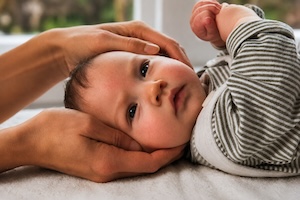
Some of the concerns we commonly assess include:
- A strong preference for looking or turning the head to one side
- Reduced or uneven neck movement
- Head shape concerns such as positional plagiocephaly
- Asymmetrical posture or movement
- Difficulty getting comfortable in certain feeding or carrying positions
- Musculoskeletal tension or apparent discomfort
- Concerns following a difficult, assisted or very fast birth
Babies may also have reflux, excessive crying, poor sleep or feeding problems. These symptoms can have many different causes. We do not assume they are caused by musculoskeletal tension or that osteopathy will fix them. Instead, we assess whether movement, comfort or musculoskeletal factors could be part of the picture and recommend medical, lactation or other assessment when appropriate.
What happens at a baby osteopathy appointment?
A baby's appointment usually starts with quite a lot of talking. We want to know what pregnancy and birth were like, how feeding is going, what you have noticed about your baby's movement and whether there are any medical or developmental concerns.
We then observe and examine your baby in a way that is appropriate for their age. Depending on why you have come in, this may include looking at:
- How comfortably your baby turns their head
- Head shape and positional preferences
- Movement and symmetry through the neck, spine, pelvis and limbs
- How your baby settles in different positions
- Musculoskeletal factors that may be relevant during feeding
- Age appropriate neurological and developmental features where relevant
You stay with your baby throughout the appointment. Feeding, cuddling or taking a break is absolutely fine. We are not trying to make a baby lie still while we complete a set routine.
Baby osteopathy is different from treating an adult
Babies are not simply treated with smaller versions of adult techniques.
The amount of force used is very light and treatment is adapted to the baby's size, stage of development and presentation. We commonly use gentle osteopathic and cranial techniques while watching how the baby responds.
Sometimes the most useful part of the appointment is the assessment itself, along with advice about handling, positioning or tummy time. Not every finding needs treatment and not every baby who comes through the door needs a course of osteopathy.
If something does not fit a straightforward musculoskeletal picture, we will say so.
Experienced osteopaths for babies and children
Paediatric osteopathy has been an area of interest at Health Within for many years. Our team includes osteopaths who have undertaken additional education in infant, child and adolescent health as well as further paediatric osteopathic training.
Rebecca Walker, Kate Leighton and Maria de Roo have particular experience treating babies.
Rebecca Walker
Rebecca is an osteopath and holds a PhD in Paediatrics. She completed New Zealand's Child and Adolescent Health course and has also undertaken James Jealous osteopathic training through Phases 1 to 3. Her background combines many years of osteopathic practice with paediatric research and a strong interest in infant and child health.
Kate Leighton
Kate has extensive experience working with babies and children. She completed New Zealand's Child and Adolescent Health course and has undertaken further paediatric education including Julie Fendell's Osteopathic Approach to Paediatrics: Introduction to Examination of the Child, Newborn to 4 Years of Age and Osteopathic Approach to the Neuromusculoskeletal System in Paediatrics, Birth to 7 Years of Age. Kate has also completed James Jealous Phases 1 to 3.
Maria de Roo
Maria has considerable experience working with babies and has undertaken James Jealous osteopathic training through Phases 1 to 3.
Other members of our team have also undertaken additional child and adolescent training. You can read more about our osteopaths on our team page.
Flat head and positional preference
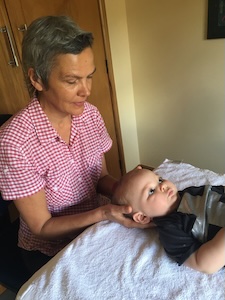
A baby who spends more time with their head turned to one side can gradually develop flattening of the skull. This is known as positional plagiocephaly. Sometimes a baby also has restricted or uncomfortable neck movement, a persistent head preference or torticollis.
For babies with these concerns, we assess head shape as well as neck movement, positioning and overall symmetry. Advice about repositioning, supervised tummy time and how your baby is handled through the day is usually part of management.
There is clinical research specifically looking at osteopathic treatment for positional plagiocephaly. A randomised controlled trial of 96 infants aged one to six months found greater improvement in cranial asymmetry when osteopathic manipulative therapy was added to repositioning advice compared with light touch and repositioning alone.1
You can read more in our article How to treat a flat head in babies.
Feeding and latching difficulties
Feeding is complicated. It involves the baby, the parent, milk supply, positioning and coordination of sucking and swallowing. Tongue function and other medical factors may also need consideration.
When a baby is having trouble feeding, our role is not to replace a lactation consultant, midwife or doctor. We can assess whether neck, jaw or other musculoskeletal factors appear to be making comfortable positioning more difficult.
Research in this area is still developing. A 2025 randomised pilot trial involving 40 newborns with feeding dysfunction found a greater improvement in LATCH scores after two osteopathic treatments compared with sham treatment.2
Feeding difficulties should be approached collaboratively. If lactation support or medical assessment is needed, osteopathy should sit alongside that care rather than replace it.
What about colic, reflux and unsettled babies?
Parents understandably look for help when their baby cries for long periods, seems uncomfortable or is difficult to settle. Colic and reflux are common reasons that families bring their babies to see our osteopaths.
A 2023 randomised clinical trial involving 84 babies with infant colic reported reductions in crying and regurgitation in babies receiving osteopathic manual therapy compared with the control group.3
Ear infections and glue ear
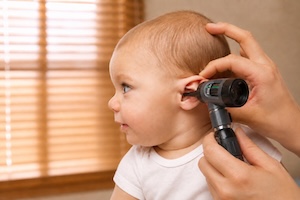
Ear concerns are common in babies, including recurrent ear infections and persistent fluid behind the eardrum, often called glue ear. These are also concerns that parents commonly bring to osteopaths.
Our osteopathic assessment considers the baby's head, neck, jaw and surrounding musculoskeletal structures, and visualisation of the ear canal and eardrum using an otoscope. Treatment, where appropriate, uses gentle techniques suited to your baby's age and presentation.
This is an area of particular interest for Rebecca Walker, whose PhD in Paediatrics focused on glue ear, giving her an extensive research background in the condition alongside her clinical experience working with babies and children.
Cranial osteopathy for babies
Many of our baby appointments include techniques from Osteopathy in the Cranial Field, usually called cranial osteopathy.
These techniques are gentle and involve light contact with areas such as the head, spine, pelvis or ribs. They are used as part of the baby's overall osteopathic assessment rather than as a separate treatment for a particular disease.
You can read more about our approach on our cranial osteopathy page.
Is osteopathy safe for babies?
At Health Within we use gentle, age appropriate techniques when treating babies. A careful history and examination come first so that we can decide whether osteopathic care is appropriate. We do not use spinal manipulation on babies.
Large observational research involving more than 1,100 infants reported no serious adverse reactions across more than 3,000 osteopathic treatments.4
When should my baby see a doctor instead?
Osteopathy does not replace medical care. Babies can become unwell quickly and sometimes a symptom that initially looks musculoskeletal needs medical assessment.
We will recommend medical review or specialist referral when a baby's history or examination raises concern. Parents should also seek prompt medical advice for things such as fever in a young baby, breathing difficulty, marked lethargy, poor feeding with signs of dehydration, seizures, persistent vomiting, sudden deterioration or whenever their baby seems seriously unwell.
Frequently asked questions about baby osteopathy
How young can a baby see an osteopath?
We see babies from the newborn period onwards. Whether an appointment is appropriate depends on the baby's health and the reason you are bringing them in.
Will the treatment hurt my baby?
Treatment will never be forceful. We use gentle techniques and continually watch how your baby responds. Babies are free to move and parents remain with them throughout the appointment.
What if my baby cries?
A crying baby may be hungry, tired, want a cuddle or simply be fed up with being examined. We can pause, change position, let you feed your baby or stop if needed.
Can I feed my baby during the appointment?
Yes. Feeding during an appointment is completely normal. It can also be useful for us to see the positions that are comfortable or difficult for your baby if feeding is part of the reason you have come in.
How many appointments will my baby need?
There is no standard number. Some babies need only an assessment and advice. Others may be reviewed after treatment to see whether movement, comfort or symmetry has changed. We will explain what we find and whether we think another appointment is worthwhile.
Do I need a referral?
No referral is required to book an osteopathy appointment. We will work alongside your GP, midwife, paediatrician, lactation consultant, physiotherapist or other members of your baby's healthcare team.
Baby osteopath in Westmere, Auckland
Health Within Osteopathy is at 141 Garnet Road in Westmere. We regularly see babies and families from Grey Lynn, Ponsonby, Pt Chevalier, Herne Bay and other parts of central Auckland.
If you are not sure which osteopath to choose, our reception team can help you find someone with the right experience for your baby.
Book online or contact us to discuss whether a baby osteopathy appointment may be suitable.
References
- Bagagiolo D, Priolo CG, Favre EM, et al. A Randomized Controlled Trial of Osteopathic Manipulative Therapy to Reduce Cranial Asymmetries in Young Infants with Nonsynostotic Plagiocephaly. American Journal of Perinatology. 2022;39(S 01):S52-S62. doi:10.1055/s-0042-1758723. PubMed
- Fons D, Watts KB, Vannitamby H, et al. Osteopathic manipulative treatment for management of feeding dysfunction in breastfed newborns. Journal of Osteopathic Medicine. 2025. doi:10.1515/jom-2024-0133. PubMed
- Martínez-Lentisco MDM, Martín-González M, García-Torrecillas JM, Antequera-Soler E, Chillón-Martínez R. Osteopathic Manual Therapy for Infant Colic: A Randomised Clinical Trial. Healthcare. 2023;11(18):2600. doi:10.3390/healthcare11182600. PubMed
- Philippi H, Faldum A, Schleupen A, et al. Osteopathic Treatment of Infants in Their First Year of Life: A Prospective Multicenter Observational Study (OSTINF Study). 2021. PubMed